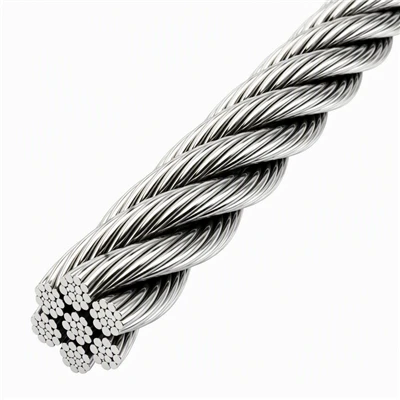
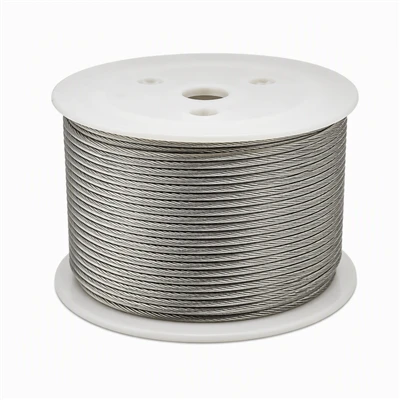
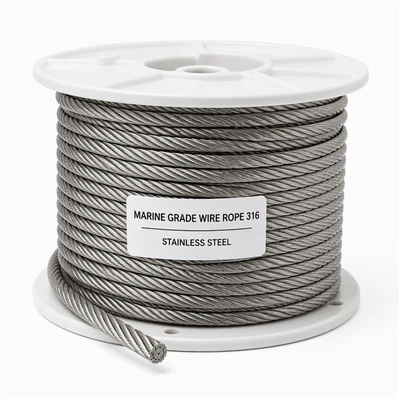
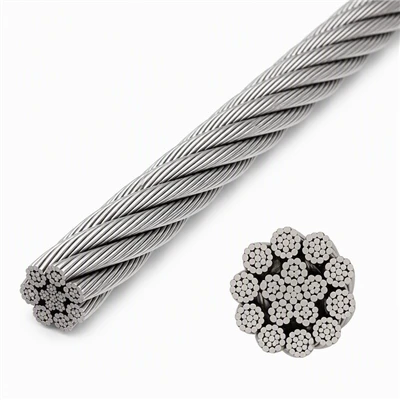
As a critical industrial load-bearing component, the performance of wire ropes is closely related to their structural design. A typical wire rope is made of multiple layers of twisted steel wires. The core structure includes three layers: core, strands, and monofilaments. These layers work together to achieve high strength, wear resistance, and fatigue resistance.
The core, located at the center of the wire rope, primarily provides support and lubrication. Common cores include fiber cores (such as natural or synthetic fibers) and metal cores (such as steel strands). Fiber cores are flexible, absorb vibration, and store lubricant. Metal cores offer increased compression resistance and high-temperature performance, making them suitable for heavy-duty applications.
Strands are a collection of multiple steel wires twisted helically around the core, typically consisting of six to eight strands. The lay direction (left-hand or right-hand) of each strand and its alignment with the core directly impact the stability of the wire rope. Strands come in a variety of configurations, including Seale, Warrington, and Filler. These structures improve breaking strength and wear resistance by optimizing wire contact. For example, Seale strands have thicker outer wires, suitable for applications subject to severe surface wear; Filler strands, on the other hand, use thinner wires to fill gaps and enhance compression resistance.
The monofilament, the basic unit of a wire rope, is typically made of carbon steel or alloy steel, and its strength is enhanced through a cold-drawing process. The diameter, tensile strength, and surface treatment (such as galvanizing for rust prevention) of the monofilament directly impact its overall lifespan. Modern wire ropes often utilize wires with special cross-sections (such as elliptical or trapezoidal) to increase the contact area between the wires and reduce stress concentration.
The structural design of a wire rope must be tailored to the specific application. For example, elevator wire ropes emphasize flexibility and uniform wear, employing a dense, multi-strand structure. Crane wire ropes, on the other hand, prioritize load-bearing capacity and prefer thicker, higher-strength strands. Furthermore, precise control of twisting process parameters (such as the lay ratio) is crucial to preventing loosening and twisting.
In summary, the structure of wire ropes is a comprehensive reflection of materials science, mechanical design, and engineering practice. Its optimization continues to drive technological advancements in fields such as industrial lifting, transportation, and marine engineering.