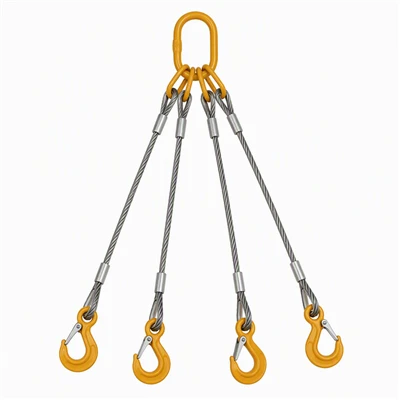
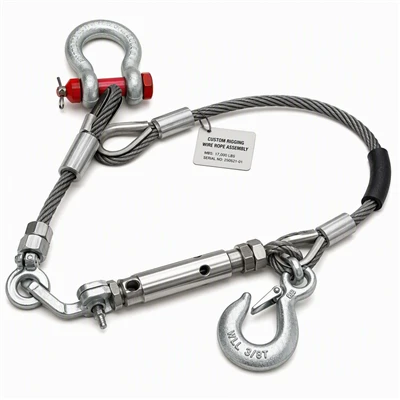
Breaking Force, WLL, and Safety Factors: What Wire Rope Buyers Must Know
When purchasing steel wire rope for cranes, hoists, lifting equipment or rigging applications, buyers often encounter terms such as Minimum Breaking Force (MBF), Minimum Breaking Load (MBL), Working Load Limit (WLL), Safe Working Load (SWL) and Safety Factor.
These terms are related, but they do not mean the same thing. Understanding the difference is essential when selecting the correct wire rope diameter, construction and strength class for a lifting application.
A wire rope's breaking force is a test or rated strength value. It is not the load that should normally be applied during operation. The permissible working load must be determined using the applicable safety factor, equipment design requirements and relevant standards.
1. Minimum Breaking Force (MBF / MBL)
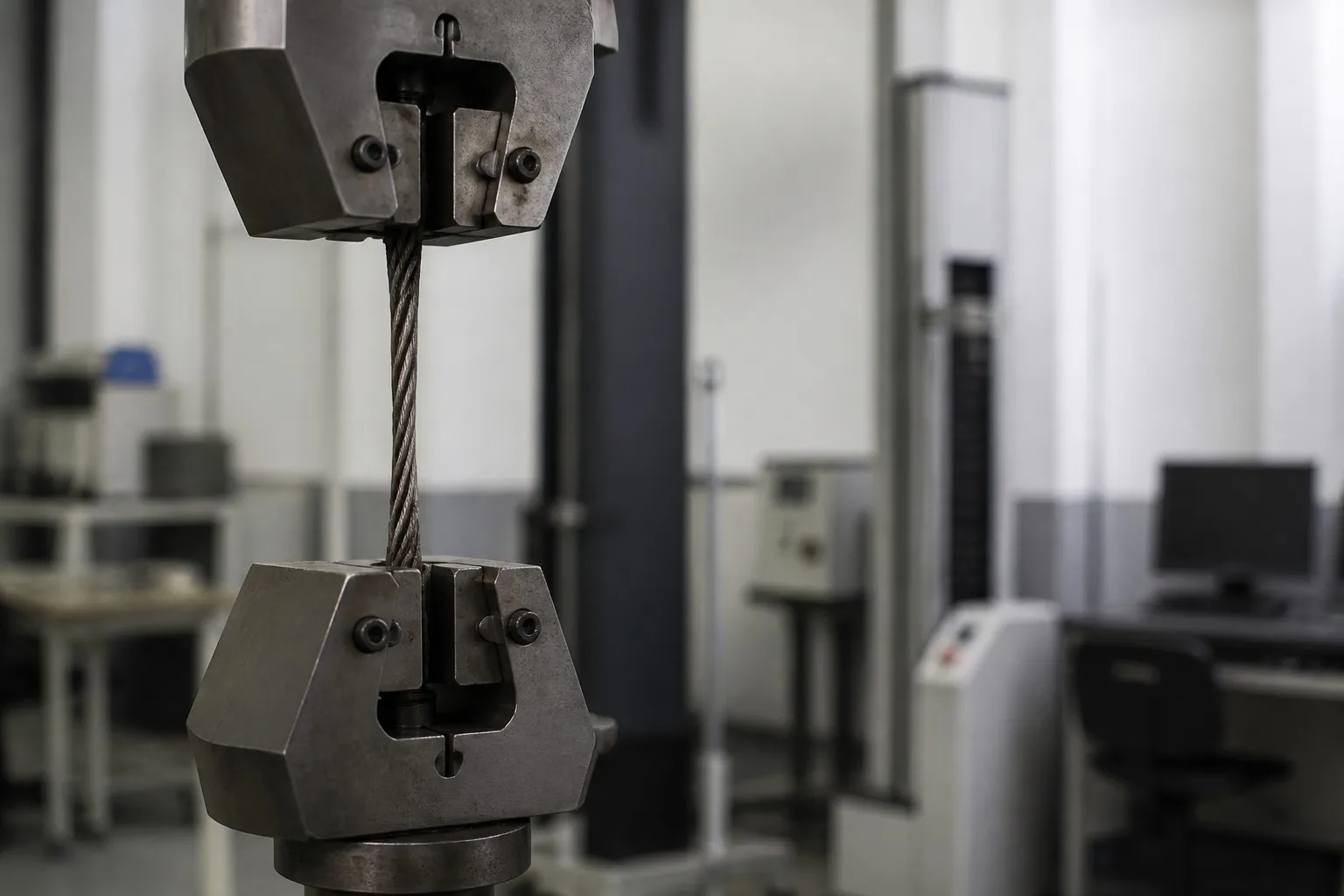
Steel wire rope tensile testing is used to verify the rope's measured breaking force against the applicable technical requirements.
Minimum Breaking Force (MBF) is the minimum specified force that a wire rope is required to withstand before breaking under the applicable test conditions and standard.
The term Minimum Breaking Load (MBL) is also commonly used in lifting and rigging specifications. Depending on the standard and industry, terminology may differ, so buyers should always confirm the definition used in the relevant technical specification.
Breaking force is determined through tensile testing or calculated according to the applicable rope standard and construction. It represents the rope's ultimate strength and should not be interpreted as the permitted operating load.
For example, a wire rope with a minimum breaking force of 100 kN does not mean that a 100 kN load can safely be suspended from the rope during normal operation.
2. What Is Working Load Limit (WLL)?
Working Load Limit (WLL) is the maximum load that a component or lifting assembly is permitted to support under specified conditions of use.
For a simple wire rope application, a basic relationship can be expressed as:
For example, if a rope has a specified minimum breaking force of 100 kN and the applicable design factor is 5:
This is a simplified engineering relationship. Actual allowable load may be lower depending on the lifting system, rope termination, reeving arrangement, bending conditions, equipment manufacturer requirements and applicable regulations.
3. What Is Safety Factor?
The Safety Factor (SF), also called the design factor in some applications, expresses the ratio between the rope's breaking strength and the allowable working load.
A higher safety factor means that a larger margin exists between the specified working load and the rope's breaking strength.
However, a higher safety factor does not automatically make an entire lifting system safe. The complete system must also consider:
- Rope construction and diameter
- Rope termination efficiency
- Sheave and drum diameter
- Bending fatigue
- Dynamic loading
- Shock loading
- Angle and reeving arrangement
- Corrosion and environmental exposure
- Wear and broken wires
- Equipment manufacturer's requirements
4. MBF vs WLL vs Safety Factor
| Term | Meaning | Used For |
|---|---|---|
| MBF | Minimum Breaking Force | Specified/tested ultimate rope strength |
| MBL | Minimum Breaking Load | Common lifting/rigging strength terminology |
| WLL | Working Load Limit | Maximum permitted working load under specified conditions |
| SWL | Safe Working Load | Traditional term for permissible working load |
| SF | Safety / Design Factor | Relationship between breaking strength and allowable load |
5. Why You Cannot Use MBF as the Working Load
A wire rope does not operate under laboratory conditions. During actual service, it is exposed to bending, fatigue, wear, corrosion, acceleration, vibration and other factors that can progressively reduce its effective strength.
A rope that initially meets its minimum breaking force specification can therefore deteriorate during service.
The difference between breaking force and working load provides a necessary margin for factors such as:
- Material variability
- Manufacturing tolerances
- Rope bending fatigue
- Wear and abrasion
- Corrosion
- Dynamic loading
- Shock loading
- Rope termination effects
- Installation conditions
- Changes in operating environment
6. Example: How Safety Factor Changes WLL
Consider a steel wire rope with a minimum breaking force of 100 kN. Different design factors produce different theoretical allowable loads.
| Design Factor | Calculation | Theoretical Load |
|---|---|---|
| 3:1 | 100 ÷ 3 | 33.3 kN |
| 4:1 | 100 ÷ 4 | 25.0 kN |
| 5:1 | 100 ÷ 5 | 20.0 kN |
| 6:1 | 100 ÷ 6 | 16.7 kN |
| 8:1 | 100 ÷ 8 | 12.5 kN |
These figures are mathematical examples only. The applicable design factor must be determined from the specific lifting application, governing standard, equipment design and manufacturer requirements.
7. Does Every Wire Rope Use the Same Safety Factor?
No. There is no single universal safety factor that applies to every wire rope application.
The required design factor depends on the application and the applicable standard or regulatory framework. A crane hoist rope, elevator rope, guy rope, general rigging rope and specialized offshore lifting rope may have different design requirements.
Buyers should therefore avoid asking a supplier simply: "What is the safety factor of this wire rope?"
A better specification is: "What is the required application, working load, rope construction, applicable standard and required design factor?"
8. Wire Rope Breaking Force Depends on More Than Diameter
Two wire ropes with the same nominal diameter can have different breaking forces. This is because breaking force depends on multiple design parameters.
| Parameter | Effect on Rope Performance |
|---|---|
| Rope Diameter | Larger diameter generally provides greater metallic cross-sectional area |
| Wire Tensile Strength | Higher wire strength can increase breaking force |
| Rope Construction | Determines metallic area, flexibility and fatigue behavior |
| Core Type | Influences support, crushing resistance and construction |
| Compaction | Can increase metallic fill and optimize rope geometry |
| Lay | Influences rope behavior, rotation and handling |
| Manufacturing Quality | Affects consistency and actual mechanical performance |
9. Breaking Force of Common Wire Rope Constructions
Wire rope buyers should compare breaking force using the same diameter, rope construction, tensile strength and applicable standard. Simply comparing "6×19 vs 6×36" without these parameters can produce misleading results.
For example, a compacted rope such as 35(W)x7 may achieve a higher metallic fill than a conventional rope of the same nominal diameter. This can provide a higher minimum breaking force potential while maintaining the required rope geometry for heavy-duty lifting applications.
Similarly, rotation-resistant and non-rotating constructions are designed for different load and rotation requirements and should not be selected solely by breaking force.
10. What Is the Difference Between WLL and SWL?
WLL and SWL are often used to describe the allowable working capacity of lifting equipment. However, terminology and legal definitions vary between standards, industries and jurisdictions.
In modern lifting product specifications, WLL is commonly used as the manufacturer's or standard-defined working limit under specified conditions. SWL is an older or broader term that may appear in engineering documents and lifting practice.
For international purchasing, it is better to define exactly what the stated capacity means rather than relying only on the abbreviation.
11. Wire Rope Termination Can Affect Capacity
The rope itself is only one part of a lifting system. The termination at each end can influence the effective strength of the assembly.
Common termination methods include:
- Socket termination
- Wedge socket
- Swaged terminal
- Wire rope clips
- Spliced termination
- Thimble and fitting assemblies
The efficiency of the termination depends on the design, installation method and applicable standard. Therefore, the WLL of a complete wire rope assembly should not automatically be calculated from the rope's MBF alone.
12. Dynamic Loads and Shock Loading
Static load calculations do not fully describe many crane and lifting operations. Starting, stopping, sudden acceleration, load swing and shock loading can temporarily increase the force applied to the rope.
For this reason, lifting equipment should be operated within its designed load and speed limits. Sudden loading should be avoided, and the complete lifting system should be designed to account for applicable dynamic effects.
A rope that appears adequate based only on static load may not be suitable for an application involving severe dynamic loading, repeated bending or shock loading.
13. What Information Should Buyers Request From a Wire Rope Supplier?
For critical lifting applications, buyers should request technical documentation rather than relying only on a product name or nominal diameter.
- Rope construction
- Nominal diameter
- Core type
- Rope grade / wire tensile strength
- Minimum breaking force
- Applicable manufacturing standard
- Lay direction
- Surface treatment
- Weight per unit length
- Dimensional tolerance
- Test certificate where required
- Material certificate where applicable
14. MBF vs WLL: A Practical Buyer Example
Suppose a crane manufacturer requires a wire rope with a minimum breaking force of at least 200 kN. The buyer should not simply ask the supplier for a "200 kN rope."
The correct purchasing process is:
- Determine the actual maximum working load.
- Identify the applicable lifting equipment standard.
- Determine the required design factor.
- Calculate the required minimum breaking force.
- Select the appropriate rope construction and diameter.
- Check compatibility with the drum and sheaves.
- Verify the rope termination and complete assembly.
- Request the appropriate technical documentation.
This approach ensures that the rope is selected as part of the complete lifting system, rather than as an isolated commodity product.
15. Common Wire Rope Buying Mistakes
Mistake 1: Treating breaking force as working load
Breaking force is an ultimate strength value. It should not be used directly as the permitted working load.
Mistake 2: Choosing rope by diameter alone
The same diameter can be available in different constructions, tensile grades and core configurations with different mechanical properties.
Mistake 3: Using one safety factor for every application
Crane, elevator, rigging and specialized lifting applications may have different design requirements.
Mistake 4: Ignoring the termination
A wire rope assembly can have a different effective capacity from the bare rope depending on the termination method.
Mistake 5: Ignoring service deterioration
The initial breaking force does not remain constant throughout the rope's service life. Wear, corrosion, broken wires and deformation can reduce the rope's condition and require replacement.
16. Frequently Asked Questions
What is the minimum breaking force of wire rope?
Minimum Breaking Force (MBF) is the minimum specified force that a wire rope is required to withstand under the applicable test or standard conditions. It represents ultimate rope strength rather than normal working capacity.
What is the difference between MBF and WLL?
MBF describes the rope's minimum breaking strength, while WLL represents the permitted working load under specified conditions. WLL is normally much lower than MBF because an appropriate safety or design factor is applied.
How do you calculate wire rope WLL?
For a simplified calculation, WLL can be expressed as minimum breaking force divided by the applicable design factor. However, actual allowable capacity must also consider the lifting system, termination, reeving arrangement, dynamic loads, applicable standards and manufacturer requirements.
Is MBL the same as MBF?
MBL means Minimum Breaking Load, while MBF means Minimum Breaking Force. They are closely related concepts and are sometimes used interchangeably in industry, but the exact definition should be confirmed against the applicable standard or product specification.
What safety factor should I use for steel wire rope?
There is no single safety factor for every wire rope application. The required design factor depends on the equipment, lifting application, applicable standard, operating conditions and manufacturer's requirements.
Does a larger wire rope always have a higher WLL?
Not necessarily. A larger diameter generally provides greater metallic area, but WLL also depends on rope construction, tensile strength, termination, safety factor and the specific lifting application.
Why do buyers need a wire rope test certificate?
A test certificate can provide documented evidence of measured mechanical properties and conformity with specified requirements. For critical lifting applications, buyers should specify the required certificate type and applicable standard before placing the order.
Can SOLITE provide wire rope breaking force data?
Yes. For applicable products, SOLITE can provide technical specifications including rope construction, diameter, tensile strength and minimum breaking force. Test documentation can be discussed according to the product, order and applicable requirements.
17. Technical Selection: What Buyers Should Send Us
To recommend the correct steel wire rope, send us the following information:
| Required Information | Example |
|---|---|
| Application | Port crane / tower crane / hoist |
| Rope Construction | 6×19 / 6×36 / 35(W)x7 |
| Diameter | 32 mm |
| Core | IWRC / FC |
| Surface | Galvanized / Bright |
| Working Load | Specified by equipment designer |
| Required Breaking Force | Specified minimum value |
| Rope Length | 500 m / 1,000 m |
| Drum Type | Single-layer / Multi-layer |
| Certificate | Test certificate / MTC as required |
18. Choose Wire Rope by the Complete System, Not One Number
The safest and most economical wire rope is not necessarily the rope with the highest breaking force. The correct selection is the rope whose construction, diameter, breaking force, flexibility, fatigue performance, corrosion resistance and termination match the actual equipment and operating conditions.
For international buyers, a technically complete RFQ should therefore include the application, working load, rope construction, diameter, core, lay, surface treatment, required breaking force, rope length and applicable standard.
Need the correct wire rope specification?
Send SOLITE your rope diameter, construction, application, working load and required breaking force. Our technical team can help identify a suitable specification and provide the corresponding datasheet and quotation.
REQUEST TECHNICAL DATA & QUOTE