35(W)x7 Compacted Strand Wire Rope: The Evolution of Port Lifting
35(W)x7 compacted strand wire rope is designed for demanding lifting applications where high breaking force, rotation resistance, crushing resistance and stable drum spooling are important. Compared with conventional stranded wire rope, compacted strand construction uses an additional compacting process to reduce the diameter of individual strands and increase the metallic fill of the finished rope.
This combination makes 35(W)x7 ropes particularly suitable for port cranes, ship-to-shore cranes, offshore lifting equipment, heavy-duty cranes and other high-capacity lifting systems.
1. Why "Compacted"?
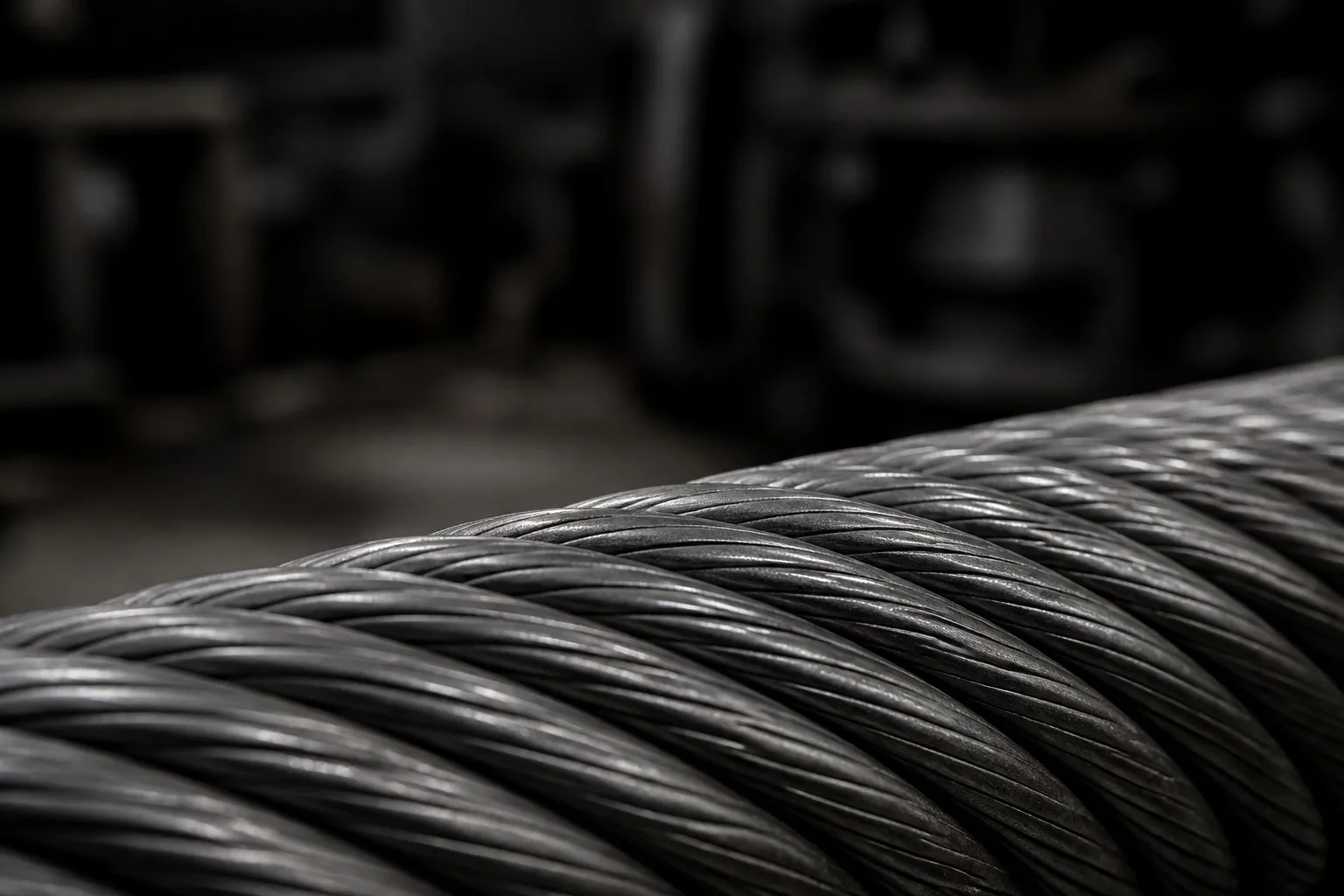
Solite Technology: High-density compacted strand surface for demanding lifting applications.
In a conventional stranded wire rope, the wires within each strand have a relatively open arrangement. During compacting, the strand is mechanically formed so that the wires are brought closer together and the overall strand profile becomes more compact.
The result is a rope with a higher metallic fill factor and a more uniform outer surface. Depending on the rope construction and manufacturing process, this can provide advantages in breaking force, surface contact, abrasion resistance and resistance to crushing.
2. How Does Strand Compaction Work?
The compacting process is performed during rope manufacturing. The individual strands are compressed and reshaped before or during the final closing operation.
A simplified manufacturing sequence is:
- Steel wires are produced to the specified diameter and tensile strength.
- Individual wires are assembled and helically formed into strands.
- The strands undergo a controlled compacting process.
- The compacted strands are closed around the rope core.
- The finished rope is inspected for diameter, construction, lay, strength and surface condition.
The exact manufacturing process varies according to rope construction, equipment and manufacturer's technology. For a high-performance crane rope, dimensional consistency and controlled strand geometry are essential because they influence how the rope interacts with sheaves and drums.
3. What Makes 35(W)x7 Different?
The designation 35(W)x7 describes a multi-strand wire rope construction consisting of seven strands around a central core, with a Warrington-type strand arrangement commonly represented by the "W" designation.
The large number of outer wires and strands provides a relatively high metallic cross-sectional area while maintaining the characteristics required for heavy lifting applications.
| Characteristic | 35(W)x7 Compacted Rope | Typical Conventional Rope |
|---|---|---|
| Strand Construction | Compacted multi-wire strands | Conventional stranded construction |
| Metallic Fill | Higher | Generally lower |
| Outer Surface | Smoother and more compact | More pronounced strand profile |
| Breaking Force Potential | High | Depends on construction and grade |
| Crushing Resistance | High when correctly designed | Application dependent |
| Drum Spooling | Stable when correctly matched to drum | Application dependent |
| Typical Application | Heavy-duty cranes and ports | General lifting applications |
4. Higher Metallic Area, Higher Breaking Force Potential
One of the principal engineering benefits of compacted strand construction is the increased metallic fill within a given rope diameter.
More steel within the same nominal rope diameter can increase the rope's available metallic cross-sectional area. When combined with appropriate wire tensile strength and optimized rope construction, this can result in a higher minimum breaking force than a comparable conventional rope of the same nominal diameter.
This can be particularly valuable when equipment designers need to achieve a required breaking force without significantly increasing rope diameter.
Compaction does not simply make a rope "stronger" by itself. The final breaking force depends on rope diameter, wire tensile strength, metallic area, construction, core, lay and manufacturing quality. Compaction is one of the design features used to optimize these parameters.
5. Why Is 35(W)x7 Suitable for Port Cranes?
Port cranes operate under demanding conditions involving heavy loads, repeated lifting cycles, multi-layer drum spooling, dynamic loading and exposure to marine environments.
These conditions place significant demands on the wire rope.
A properly specified 35(W)x7 compacted rope can provide a combination of:
- High breaking force: Suitable for high-capacity lifting systems.
- Rotation resistance: Multi-layer construction helps control rope rotation under load.
- High metallic fill: More steel area within the rope diameter.
- Compacted surface: Provides a smoother outer profile.
- Crushing resistance: Helps withstand pressure associated with multi-layer spooling when properly matched to the equipment.
- Fatigue performance: Suitable construction can support repeated bending cycles when matched with correct sheaves and operating conditions.
6. Multi-Layer Drum Performance
One of the most important considerations for port crane ropes is how the rope behaves when spooled onto a multi-layer drum.
During multi-layer winding, the rope can be subjected to radial pressure, crossing loads and localized contact between adjacent rope layers. Poor rope selection or incorrect drum configuration can accelerate crushing, flattening, wear and uneven spooling.
The compacted outer surface of a 35(W)x7 rope can provide a more consistent contact profile between adjacent rope turns. This may help distribute contact forces more evenly under suitable operating conditions.
However, rope construction alone cannot eliminate spooling problems. The following equipment parameters must also be correctly matched:
- Drum diameter
- Drum groove geometry
- Fleet angle
- Number of rope layers
- Rope diameter
- Drum winding direction
- Rope lay direction
- Working load and lifting speed
7. Compacted Strand vs Conventional Strand
| Feature | Compacted Strand | Conventional Strand |
|---|---|---|
| Strand Density | Higher | Lower |
| Outer Profile | More compact and smooth | More pronounced strand profile |
| Metallic Fill | Higher | Lower in comparable designs |
| Breaking Force | Potentially higher for same diameter | Depends on construction |
| Surface Contact | More uniform | More concentrated at strand peaks |
| Crushing Resistance | Generally improved in suitable designs | More application dependent |
| Typical Use | Heavy-duty lifting | General-purpose lifting |
8. 35(W)x7 for Marine and Port Environments
Port and marine applications introduce another challenge: corrosion. A high-performance lifting rope must therefore be selected based not only on mechanical performance but also on environmental exposure.
For port equipment operating in coastal or salt-laden environments, suitable surface protection and maintenance are important. Depending on the application, galvanized steel wire rope may provide improved atmospheric corrosion resistance compared with bright/uncoated carbon steel rope.
For severe marine exposure, rope selection should consider:
- Galvanizing quality and coating condition
- Lubrication system
- Salt spray and humidity exposure
- Drainage and water accumulation
- Inspection frequency
- Rope storage and handling
- Expected service cycles
Corrosion protection does not replace regular inspection. A rope operating in a marine environment should be monitored for corrosion, broken wires, diameter reduction, wear and deformation throughout its service life.
9. 35(W)x7 vs 35x7: What Is the Difference?
Buyers sometimes use 35x7 and 35(W)x7 interchangeably, but the exact strand construction should always be confirmed from the manufacturer's technical drawing and datasheet.
The "W" designation generally indicates a Warrington-type wire arrangement within the strand. Construction details can affect the rope's metallic area, flexibility, breaking force, rotation resistance and fatigue behavior.
When requesting a quotation, buyers should therefore provide the complete rope designation rather than relying only on a general term such as "35x7 crane rope."
10. Key Parameters to Specify When Ordering 35(W)x7
For an accurate quotation and technical recommendation, provide as much of the following information as possible:
- Nominal diameter: For example 20 mm, 24 mm, 28 mm, 32 mm, 36 mm or customized.
- Rope construction: 35(W)x7 or specified equivalent construction.
- Core: Confirm the required core configuration.
- Surface: Galvanized or bright/uncoated according to the application.
- Tensile strength: Specify the required wire tensile strength class.
- Lay: Right-hand or left-hand lay as required by equipment design.
- Rope length: Specify total required length or reel length.
- Breaking force: Provide required minimum breaking force where available.
- Application: Port crane, ship-to-shore crane, offshore crane, hoist or other lifting equipment.
- Drum configuration: Single-layer or multi-layer winding.
11. Inspection and Maintenance of 35(W)x7 Rope
Even a high-performance compacted wire rope requires proper maintenance. Inspection should focus on areas where bending, pressure and wear are concentrated.
- Check for visible broken wires.
- Measure rope diameter and compare with previous records.
- Inspect for external wear and abrasion.
- Check for corrosion and loss of metallic section.
- Inspect for kinks, flattening and strand deformation.
- Check drum and sheave condition.
- Verify correct lubrication.
- Pay special attention to crossover zones on multi-layer drums.
- Record inspection results and monitor deterioration trends.
For crane applications, inspection and discard decisions should follow the applicable equipment requirements, manufacturer's instructions and relevant standards such as ISO 4309.
12. Frequently Asked Questions
What is 35(W)x7 wire rope used for?
35(W)x7 wire rope is commonly used for heavy-duty lifting applications where high breaking force and resistance to rotation are required. Typical applications include port cranes, ship-to-shore cranes, offshore lifting equipment and large industrial cranes.
What does the W mean in 35(W)x7?
The "W" generally refers to a Warrington-type wire arrangement within the rope strand. The exact construction should be confirmed against the manufacturer's technical specification because rope designations can vary by manufacturer and standard.
What is a compacted strand wire rope?
A compacted strand wire rope is manufactured by mechanically compacting the individual strands, bringing the wires closer together and creating a denser strand profile. This can increase metallic fill and produce a smoother rope surface.
Is compacted wire rope stronger?
Compacted construction can provide a higher metallic fill and therefore a higher breaking force potential for a given nominal diameter. However, actual breaking force depends on rope construction, wire tensile strength, core, diameter and manufacturing quality.
Why are compacted ropes used on port cranes?
Port cranes often require high-capacity lifting ropes that can withstand repeated bending and multi-layer drum spooling. Compacted strand construction can provide high metallic fill, a smoother outer profile and improved resistance to crushing in suitable applications.
Is 35(W)x7 a non-rotating wire rope?
35(W)x7 is commonly used as a rotation-resistant or rotation-reducing crane rope construction, but the exact rotational behavior depends on the complete rope design, lay, core and manufacturer specification. The required application classification should always be confirmed from the technical datasheet.
What is the difference between compacted and non-compacted wire rope?
Compacted rope strands undergo an additional forming process that increases strand density and creates a smoother surface. Non-compacted strands retain a more conventional geometry. Compaction can improve metallic fill, surface contact and crushing resistance depending on the rope design.
How do I choose the correct 35(W)x7 wire rope?
The selection should consider rope diameter, construction, core, tensile strength, breaking force, lay direction, drum diameter, sheave diameter, number of drum layers, lifting load, operating cycles and environmental conditions.
13. Why Choose SOLITE 35(W)x7 Compacted Wire Rope?
For demanding crane applications, wire rope performance depends on both rope design and manufacturing consistency. SOLITE focuses on controlled wire rope production for industrial lifting applications, with technical support for rope construction, diameter, surface treatment, packaging and application requirements.
- 35(W)x7 compacted strand wire rope options
- Galvanized and uncoated surface options
- Multiple diameters and rope lengths
- Customized reel and packaging solutions
- Technical datasheet support
- Application-based rope selection
- OEM and customized wire rope supply
Get a technical recommendation, datasheet and quotation for 35(W)x7 compacted strand wire rope.
Request Datasheet & Quote