AISI 304 vs 316 Stainless Steel Wire Rope: Marine Grade Selection
Choosing between AISI 304 and AISI 316 stainless steel wire rope depends primarily on the environment, corrosion exposure, mechanical requirements and expected service life. Both grades provide excellent corrosion resistance compared with carbon steel wire rope, but AISI 316 offers better resistance to chloride-induced pitting and crevice corrosion because of its molybdenum content.
For marine, coastal, offshore and saltwater applications, 316 stainless steel wire rope is often preferred. However, 304 stainless steel wire rope remains a cost-effective solution for many indoor, architectural, general industrial and moderately corrosive environments.
AISI 304 vs 316: What Is the Difference?
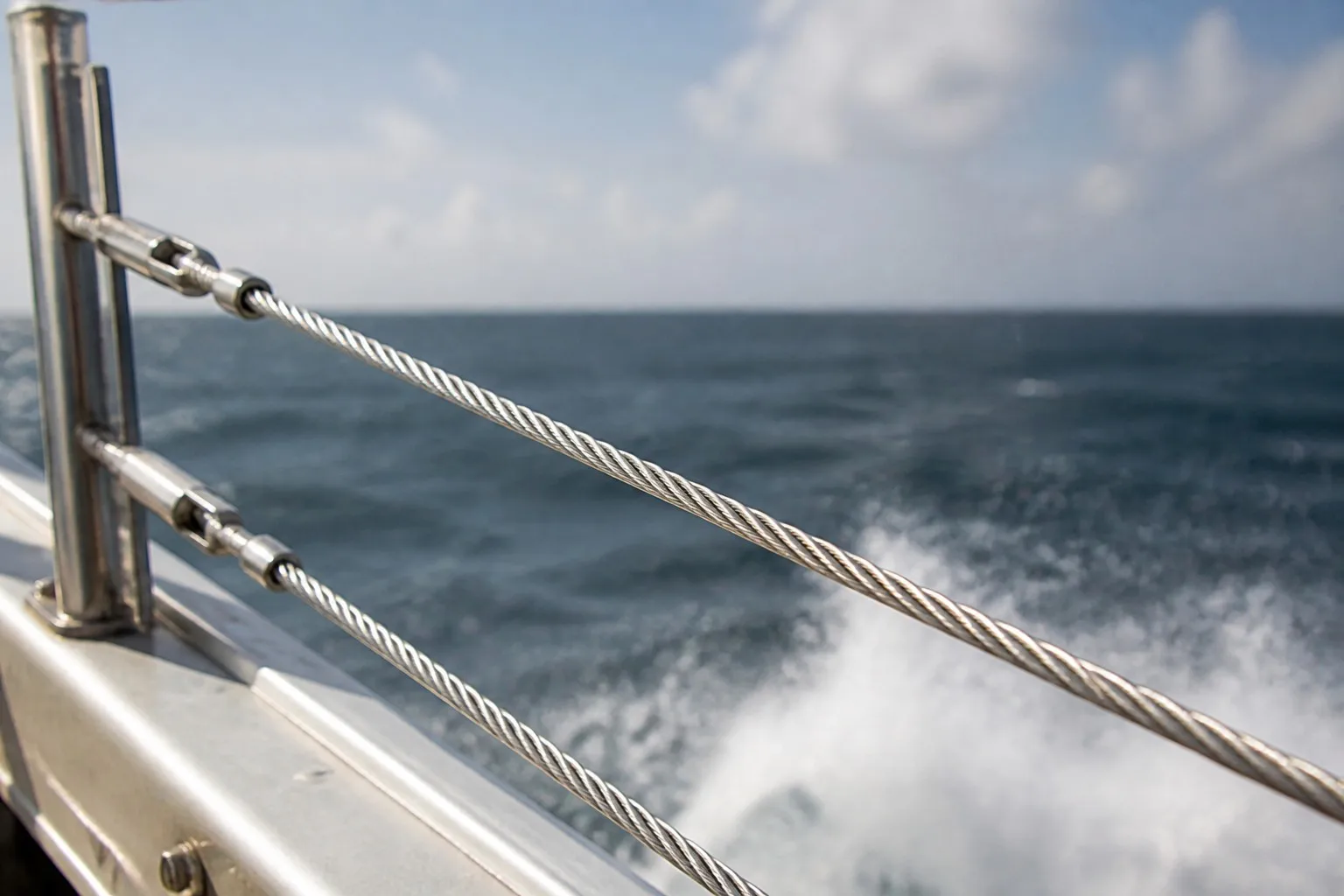
AISI 304 and AISI 316 are both austenitic stainless steels. Their corrosion resistance comes primarily from chromium, which forms a thin passive oxide layer on the steel surface.
The major difference is that 316 stainless steel contains molybdenum. This addition improves resistance to localized corrosion, particularly pitting and crevice corrosion in chloride-containing environments.
| Property | AISI 304 | AISI 316 |
|---|---|---|
| Stainless Steel Family | Austenitic stainless steel | Austenitic stainless steel |
| Chromium | Typically 18% | Typically 16–18% |
| Nickel | Typically 8–10.5% | Typically 10–14% |
| Molybdenum | Generally not intentionally added | Typically 2–3% |
| General Corrosion Resistance | Excellent | Excellent to superior |
| Chloride Resistance | Moderate | Higher |
| Pitting Resistance | Good in moderate environments | Better in chloride environments |
| Marine Suitability | Limited / application dependent | Preferred |
| Relative Cost | Lower | Higher |
Why Does 316 Perform Better in Marine Environments?
The key advantage of AISI 316 is its molybdenum content. Molybdenum improves the stability of the passive surface layer and increases resistance to localized attack caused by chloride ions.
This is particularly important in environments exposed to:
- Seawater and salt spray
- Coastal humidity
- Marine atmospheric exposure
- Offshore structures
- Swimming pools and chlorinated water
- Deicing salts
- Chloride-containing industrial environments
When chloride deposits remain on a stainless steel surface, localized corrosion can develop even though the overall surface still appears relatively clean. Pitting corrosion can therefore be more important than general surface rust when selecting a stainless steel wire rope for marine service.
Is 316 Stainless Steel Always Better Than 304?
Not necessarily.
AISI 316 provides higher resistance to chloride-induced corrosion, but that does not mean it is automatically the best choice for every wire rope application.
If the wire rope is used in a dry indoor environment, architectural installation, fitness equipment, general machinery or a location with limited chloride exposure, 304 stainless steel wire rope may provide an appropriate balance between corrosion resistance and cost.
For continuously exposed marine, offshore or high-salinity applications, 316 is generally the safer material selection when corrosion resistance is a major design requirement.
304 vs 316 Stainless Steel Wire Rope by Application
| Application | Recommended Grade | Reason |
|---|---|---|
| Indoor architectural cable | 304 | Good corrosion resistance with lower material cost |
| Gym equipment cable | 304 / 316 | Depends on sweat, humidity and required service life |
| General industrial equipment | 304 | Suitable for many moderate environments |
| Outdoor architectural railing | 304 / 316 | Depends on location and chloride exposure |
| Coastal building | 316 | Better resistance to salt-laden atmosphere |
| Marine equipment | 316 | Improved chloride and pitting resistance |
| Offshore equipment | 316 | Higher corrosion resistance in severe marine environments |
| Seawater exposure | 316 | Better localized corrosion resistance |
| Pool environments | 316 | Improved resistance to chloride-containing environments |
| Food processing equipment | 304 / 316 | Grade selection depends on chemicals and cleaning conditions |
304 Stainless Steel Wire Rope: When Should You Choose It?
AISI 304 stainless steel wire rope is widely used where good corrosion resistance, clean appearance and cost efficiency are required.
Typical applications include:
- Architectural cable systems
- Balustrades and railing systems
- Indoor and semi-outdoor applications
- Fitness equipment
- General industrial equipment
- Display and suspension systems
- Light-duty marine-adjacent applications where chloride exposure is controlled
304 is often the practical choice when the application does not involve continuous seawater exposure or severe chloride contamination.
316 Stainless Steel Wire Rope: When Should You Choose It?
AISI 316 stainless steel wire rope is recommended when corrosion resistance is a critical design consideration, particularly where chloride exposure is expected.
Typical applications include:
- Marine rigging
- Boat and yacht hardware
- Offshore structures
- Coastal architectural systems
- Seawater-related equipment
- Swimming pool environments
- Salt spray exposed structures
- Marine lifting and securing applications
- Industrial environments containing chlorides
316 should not be considered completely corrosion-proof. In severe marine environments, design details, surface contamination, crevices, stagnant water, cleaning practices and exposure conditions can all influence actual corrosion performance.
Does Distance From the Ocean Determine Whether 304 or 316 Is Required?
There is no universal engineering rule stating that 316 stainless steel must be used within a specific distance, such as 5 km from the ocean.
Actual corrosion exposure depends on multiple factors, including:
- Salt concentration in the atmosphere
- Wind direction and salt spray
- Humidity and condensation
- Frequency of rainfall and surface washing
- Distance from direct seawater exposure
- Installation geometry and drainage
- Surface contamination
- Crevices and areas where salt deposits can accumulate
- Cleaning and maintenance practices
Therefore, material selection should be based on the actual environmental severity rather than a simple distance-to-coast calculation.
304 vs 316: What About Strength?
For stainless steel wire rope, corrosion resistance is only one part of the design. The actual breaking force depends on factors such as wire rope diameter, construction, tensile strength of the wires, core configuration, lay and manufacturing process.
For example, 7×7 and 7×19 stainless steel wire ropes can be manufactured in different diameters and strength configurations. Therefore, it is not technically correct to assume that a 316 rope is automatically stronger than a 304 rope simply because it has a higher grade designation.
When selecting a wire rope, buyers should specify both the stainless steel grade and the required rope construction, diameter, tensile strength and breaking load.
304 vs 316 Stainless Steel Wire Rope: Cost Considerations
316 stainless steel normally costs more than 304 because of its alloy composition, particularly the addition of molybdenum.
However, the lowest initial purchase price is not always the lowest total cost. In a corrosive environment, selecting a more corrosion-resistant wire rope may help reduce replacement frequency, maintenance requirements and downtime.
| Consideration | 304 | 316 |
|---|---|---|
| Initial Material Cost | Lower | Higher |
| General Corrosion Resistance | Excellent | Excellent |
| Chloride Resistance | Moderate | Higher |
| Marine Applications | Application dependent | Preferred |
| Potential Maintenance Requirement in Marine Environment | Higher | Lower relative risk |
| Best Value | Moderate environments | Corrosive environments |
How to Select the Right Stainless Steel Wire Rope
Before choosing between 304 and 316, evaluate the following parameters:
- Environment: Indoor, outdoor, coastal, marine, offshore or chemical exposure.
- Chloride Exposure: Determine whether the rope will contact seawater, salt spray or chloride-containing chemicals.
- Rope Construction: Select 7×7, 7×19 or another construction according to flexibility and application requirements.
- Diameter: Confirm the required rope diameter and dimensional tolerance.
- Breaking Load: Verify the required minimum breaking force.
- Flexibility: Consider the number and diameter of sheaves, bending cycles and operating movement.
- Surface Finish: Consider whether bright, polished or other surface requirements apply.
- End Termination: Check compatibility with terminals, swage fittings, thimbles and other hardware.
- Service Life: Compare initial material cost with expected replacement and maintenance requirements.
304 vs 316 Stainless Steel Wire Rope: Quick Decision Guide
Choose AISI 304 when:
- The environment is dry or moderately corrosive.
- Chloride exposure is limited.
- The application is primarily indoors or protected.
- Cost efficiency is important.
Choose AISI 316 when:
- The rope is exposed to seawater or salt spray.
- The application is located in a severe coastal environment.
- The rope is used offshore or in marine equipment.
- Resistance to chloride-induced pitting is a major requirement.
- Long-term corrosion resistance is prioritized over initial material cost.
Frequently Asked Questions
Is 316 stainless steel wire rope better than 304?
316 generally provides better resistance to chloride-induced pitting and crevice corrosion than 304. However, 304 can be the more economical and appropriate choice for indoor, architectural and moderately corrosive environments.
Why is 316 stainless steel better for marine applications?
316 contains molybdenum, which improves resistance to localized corrosion in chloride-rich environments. This makes 316 a preferred stainless steel grade for many marine, coastal and offshore applications.
Can 304 stainless steel wire rope be used outdoors?
Yes. 304 stainless steel wire rope can be used outdoors when the environment is not highly exposed to chlorides or severe salt contamination. For coastal and marine environments, 316 is generally preferred.
Is 316 stainless steel corrosion-proof?
No. 316 has excellent corrosion resistance but is not completely corrosion-proof. Severe chloride exposure, stagnant seawater, crevices, contamination and poor maintenance can still cause localized corrosion.
Is 316 stronger than 304 stainless steel wire rope?
Not necessarily. Wire rope breaking force depends primarily on diameter, construction, wire tensile strength, core and manufacturing parameters. Stainless steel grade alone does not determine the final breaking load.
What stainless steel wire rope is best for seawater?
AISI 316 stainless steel wire rope is generally preferred for seawater and severe marine exposure because of its improved resistance to chloride-induced localized corrosion. The final selection should also consider rope construction, diameter, breaking load and the specific application.
What is the best stainless steel wire rope for coastal buildings?
316 is generally preferred for exposed coastal installations, particularly where salt spray and chloride deposits are expected. 304 may still be suitable for protected areas or locations with lower corrosion severity.
Need Help Selecting 304 or 316 Stainless Steel Wire Rope?
The correct stainless steel wire rope depends on more than the material grade. Tell us your application, rope diameter, construction, working environment, required breaking load and quantity, and our technical team can recommend a suitable rope configuration.
SOLITE supplies 304 and 316 stainless steel wire rope in multiple constructions and diameters, including 7×7, 7×19 and customized wire rope assemblies for industrial, architectural, marine and fitness applications.
Compare 304 vs 316 for your application.
Consult Wire Rope Experts