Beyond the 10:1 Factor: Decoding the Engineering Logic of Safety Margins in Passenger Lifts
SOLITE GLOBAL ENGINEERING NEWS | ISSUE 2026-Q4
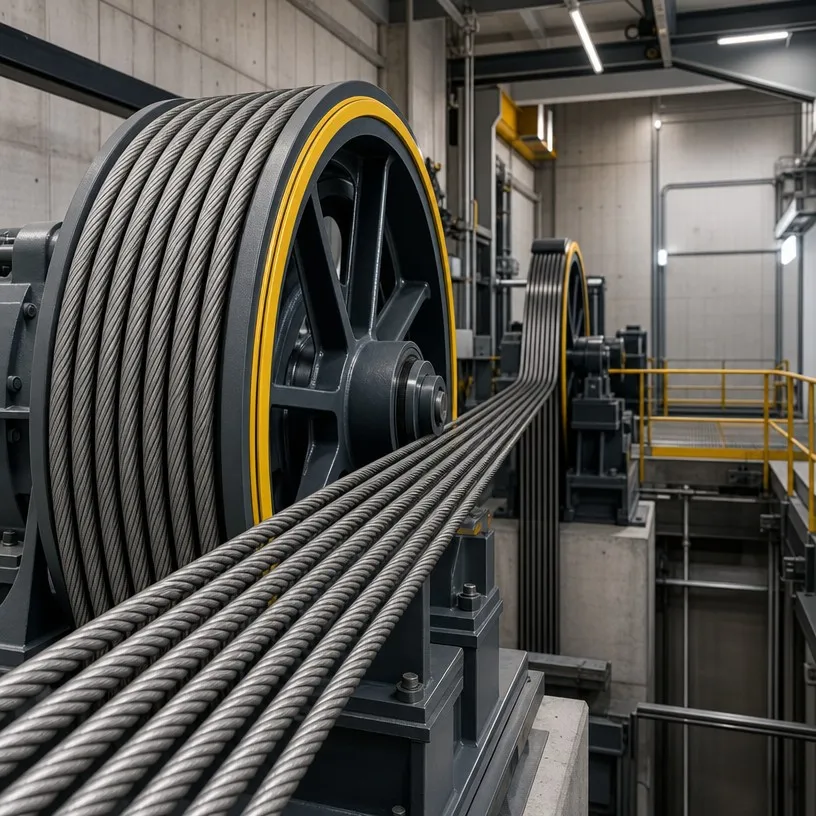
High-precision industrial documentation: Product details and application scenarios.
The safety of human-passenger transport is governed by some of the most rigorous standards in engineering-most notably the "10:1 Safety Factor." While this number is often cited as a static requirement, the underlying logic is a complex intersection of probability, metallurgy, and dynamic risk management. Compliance is not just about meeting the ratio; it's about understanding why the ratio exists.
The Probability of Failure:
A safety factor of 10:1 means that the rope is theoretically capable of holding ten times the maximum rated load. Why is such a seemingly excessive margin required? In the life cycle of a passenger lift, a rope is subjected to factors that lab tests cannot fully replicate: microscopic sheave misalignment, variable acceleration curves, and the invisible ingress of humidity. The 10:1 factor acts as a "buffer zone" for the unexpected, ensuring that even as the rope loses 10% of its cross-sectional area due to wear, it remains significantly within the zone of safety.
Compliance with ASTM A1023 and EN 12385:
Modern standards have evolved from simple breaking strength to "Operational Integrity." ASTM A1023, specifically for high-rise buildings, mandates rigorous testing for "constructional stretch" and "torque-neutrality." If a rope untwists even slightly under high tension, it creates lateral forces that vibrate against the guide rails, compromising passenger comfort. At SOLITE, our compliance protocol involves a "Digital Stress Fingerprint" for every lift rope batch, ensuring that the torque-balance is verified to 99.9% accuracy before shipping.
The Human Trust Factor:
For building managers, compliance is the baseline of legal liability, but for SOLITE, it is the baseline of human trust. We advocate for a "Transparent Certification" model, where our MTCs include not just the breaking force, but the specific stress-strain curve of the rope. In the vertical city, safety isn't a number-it is a documented engineering culture that leaves zero room for the "unforeseen."
Project Specification Support
Do you require technical comparative data or dynamic simulation twins for your specific hoisting infrastructure? Contact our dedicated engineering desk for a bespoke technical dossier.