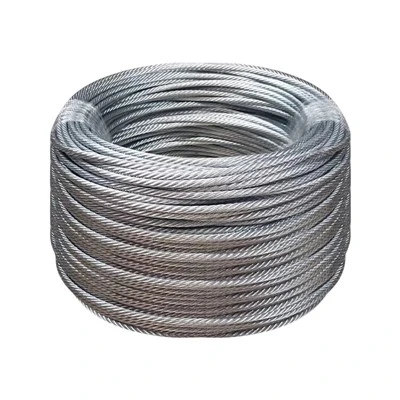
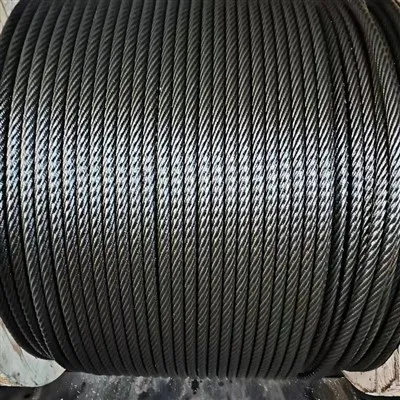
Anti-rotation wire rope is a specialised wire rope specifically designed to address the issues of 'self-rotation, twisting, and kinking' that occur in ordinary wire ropes under tension.Anti-rotation wire ropes employ multiple strands with opposing lay directions for inner and outer layers (e.g., right-hand lay for outer layer, left-hand lay for inner layer). Under load, the torsional forces of inner and outer layers counteract each other, significantly suppressing self-rotation and maintaining load stability.
Working Principle
Inward and outward rotation in opposite directions, with torque cancellation
The structure of anti-rotation steel wire ropes typically comprises multiple layers of strands. Crucially, the lay direction of the inner strands is opposite to that of the outer strands.
Self-balancing under load
When the wire rope is tensioned, the rotational force (torque) generated by the outer strands is counteracted by the opposing rotational force produced by the inner strands. This arrangement ensures the entire wire rope remains stable, preventing it from "slackening" and twisting under load as ordinary ropes would.
When a wire rope, subjected to a load equivalent to 20% of its breaking tension and with a free length reaching 1000 times its diameter, can be rotated by no more than 360° (i.e., a full turn), it may be termed an anti-rotation wire rope.
Product images


Core Advantages
Single-rope vertical lifting and long-distance hoisting ensure the load remains stable and secure, preventing rotation or swaying, thereby delivering safe and efficient operation.
Multi-layered reverse construction ensures even stress distribution, minimising the occurrence of curling, knotting, or strand separation.
At the same diameter, its breaking strength is approximately 30% higher than that of ordinary ropes, with a smoother surface and longer wear resistance lifespan.
Even if broken, the wire rope remains in place without scratching the drum or sheave, and does not affect the operation of other wires.
It is not that rotation is entirely prevented, but rather that the rotational angle is controlled within standard limits.
Applicable scenarios

Tower crane, truck-mounted crane, truck-mounted crane

Deep shaft hoisting, vertical shaft balancing rope, long-distance vertical lifting

Precision high-altitude lifting operations, bridge/marine engineering

Power construction traction ropes, oilfield sucker rods, specific traction ropes for lifts
In essence, anti-rotation wire rope is a specialised cable engineered to achieve self-balancing under load through the counter-rotational twisting of its inner and outer layers. This design sacrifices some flexibility in bending performance in exchange for invaluable torsional stability, rendering it an indispensable stabilising force in modern lifting machinery-particularly in high-altitude, deep-water, and unguided operations.