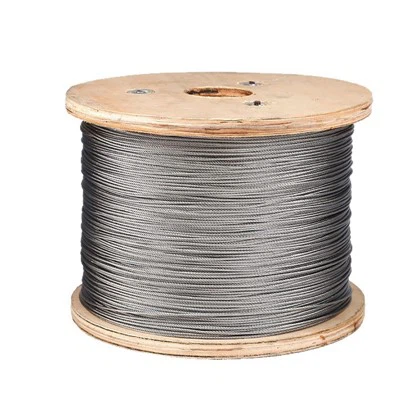
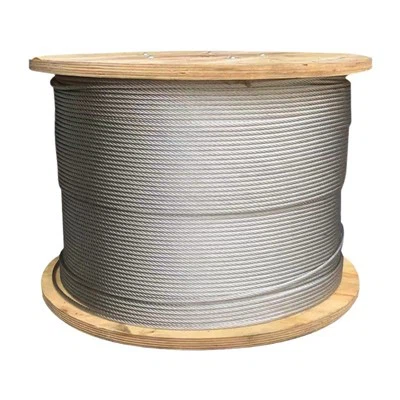
Anti-rotation wire ropes feature a special construction in which the inner and outer strands are twisted in opposite directions, thereby counteracting the rotational torque generated under load. This effectively eliminates the problems commonly associated with standard wire ropes, such as rotation under load, uncontrolled swaying of the load, twisting and loosening of the rope, and premature wire breakage. Consequently, anti-rotation wire ropes are primarily used when lifting freely suspended loads without guides, preventing the rope's own rotation from causing the hook or load to twist, thereby ensuring the safety and stability of lifting operations.
Applications of anti-rotation steel wire ropes
Anti-rotation wire ropes must be used whenever the wire rope is prone to spontaneous twisting during operation, the load is not guided, the rope is suspended over a long distance, there is multi-layer coiling, or where the stability and safety of the lift are of the utmost importance. The specific situations and scenarios in which they are used can be divided into the following five categories.
Unguided vertical single-rope lifting operations
Under such conditions, standard steel wire ropes are subject to torsional forces, causing the load to rotate and sway in mid-air. This not only prevents precise positioning but also poses risks of the load colliding with objects, the wire rope twisting and fraying, and potential breakage. Whenever lifting is carried out using a single rope without any guide rails or guiding devices to restrain the load, and the entire operation takes place in mid-air, anti-rotation steel wire ropes must be used.
Operation of multi-layer winding drums and equipment with high rope capacity
When the drum of a hoisting device requires multi-layer winding of wire rope (with a large rope capacity and extremely long lifting travel), the layers of ordinary wire rope are subject to mutual compression and friction due to torsional forces, leading to rapid wire breakage, deformation, loosening, and even jamming of the drum. In such operating conditions, anti-rotation wire rope must be selected; its compact structure, resistance to compression and absence of torsional forces enable it to meet the load-bearing requirements of multi-layer winding.
Precision Lifting and Positioning Operations
In work scenarios requiring precise alignment and smooth lifting and lowering, where any swaying or displacement of the load is strictly prohibited, even slight twisting of standard wire ropes can lead to positioning errors and equipment collisions. Anti-rotation wire ropes must therefore be used to ensure zero twisting and stable lifting and lowering, thereby meeting the requirements of precision operations.
Specialised Engineering and High-Risk Operations
Certain specialised engineering operations involve unique working conditions where steel wire ropes must not only bear heavy loads but also withstand external disturbances and eliminate the risk of twisting. Ordinary steel wire ropes are unable to meet these requirements, and anti-rotation steel wire ropes must therefore be selected.
Applications prone to external disturbances and requiring high resistance to twisting
In environments with strong winds outdoors, confined working spaces, or conditions involving frequent starts and stops, standard steel wire ropes are highly susceptible to external forces that exacerbate rotation, leading to twisting, coiling and tangling. In such scenarios, anti-rotation steel wire ropes should be the preferred choice.
Although anti-rotation wire ropes resolve the issue of rotation, they have a common drawback: their resistance to bending fatigue is generally inferior to that of standard wire ropes of the same diameter. Consequently, when selecting such ropes, it is necessary to balance anti-rotation performance against bending life.